What Metering Data Really Reveals About Substations – Our Contribution to the AGFW Research Project
We are pleased to share the completion of a project we took part in together with the AGFW and three municipal district heating providers – one that has produced some interesting results.
Background: Heating System Inspections Meet Data Analysis
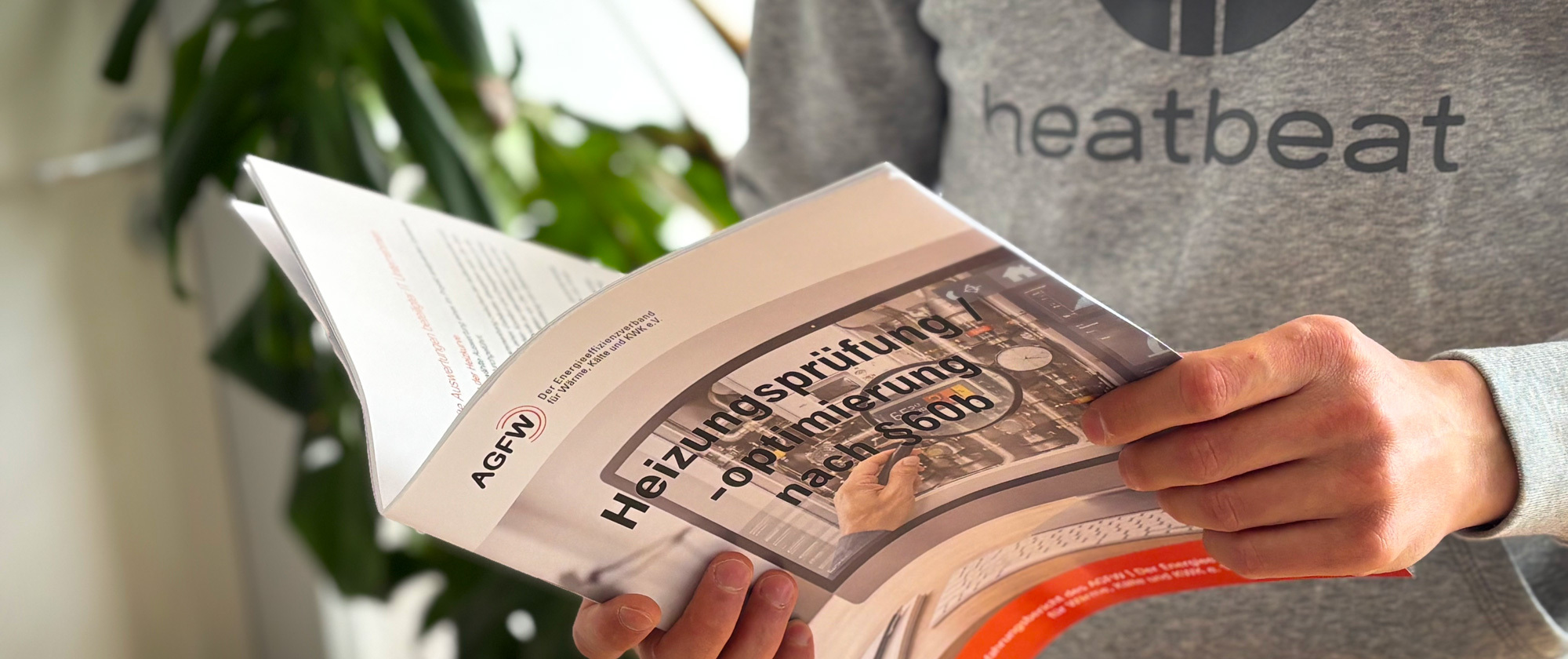
The AGFW conducted a research project to explore whether data-driven analysis of heat substations could serve as a meaningful complement to – or even a substitute for – the conventional heating system inspection required under §60b of the German Buildings Energy Act (GEG). The municipal utilities of Rosenheim, Nuremberg (N-ERGIE), and Leipzig provided time-resolved metering data from a total of 12 substations, each covering a full year of operation. In parallel, certified experts carried out conventional heating inspections in the same buildings.
Several software vendors were invited to analyse the metering data, identify operational faults, and develop optimisation recommendations. We took on this challenge using our Digital Twin approach and are proud to have performed very well.
Detecting Faults, Improving Operations
The results confirm what we observe time and again in our day-to-day work with network operators: district heating systems hold considerable optimisation potential that can be unlocked efficiently and without extensive on-site effort, given the right analytical tools. Remote-readable heat meters provide the data foundation required for this, from identifying suboptimal settings to generating actionable recommendations for network operations.
Low return temperatures, balanced pressure differentials, and well-configured substations have a direct positive impact on network losses, system efficiency, and capacity for renewable energy sources. The project demonstrates that these goals are achievable quickly and practically through data-driven analysis.
Digital Analysis and Physical Modelling: A Powerful Combination
The heatbeat Digital Twin combines continuous metering data analysis with physical network modelling. This means we not only detect operational anomalies, but can also explain why they occur and which measures will actually help. The AGFW project has demonstrated that exactly this approach – straightforward, scalable, and data-driven – delivers real results.
Thanks to the AGFW and the Participating Utilities
We would like to extend our sincere thanks to the AGFW for initiating and carefully coordinating this project, as well as to Stadtwerke Rosenheim, N-ERGIE Nürnberg, and Stadtwerke Leipzig for making their metering data available. Without this openness and willingness to collaborate, a hands-on comparison of different analytical approaches would not have been possible.
Remote-Readable Meters as the Foundation for Continuous Optimisation
More and more operators are deploying remote-readable meters, and with them, the foundation for exactly the kind of analysis this project has demonstrated. The potential is real and immediately actionable: better equipment settings, lower network losses, and greater capacity for renewable energy.
The heatbeat Digital Twin is a platform built precisely for this purpose, not as a one-time inspection, but as a continuous companion in day-to-day network operations. The full report is available directly from the AGFW: www.agfw.de/forschung/60b-geg