Project structure and process
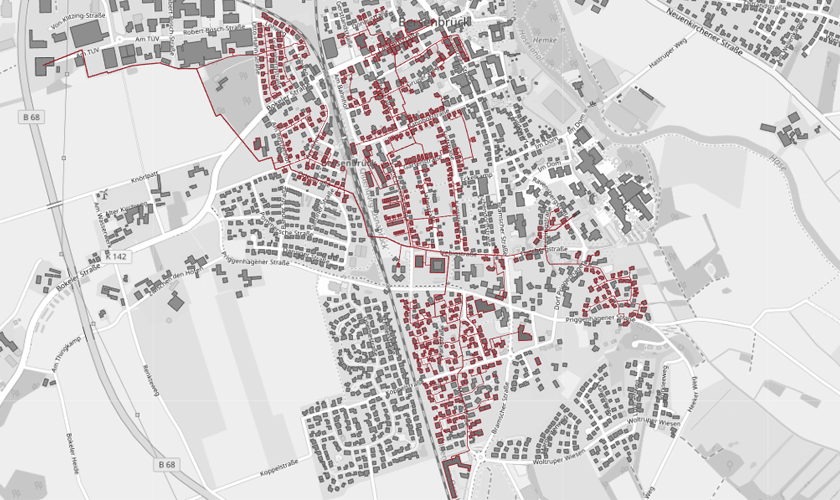
As part of the feasibility study, a comprehensive inventory of the area to be supplied was first carried out. Around 900 potential connection customers were identified and their connection capacity estimated. The data collected was systematically digitized and structured in heatbeat Digital Twin. Sorting the potential customer connections according to interest or contracts already concluded enabled targeted planning of the supply.
The existing main route with dimensions DN 300 – DN 200 formed the basis for network planning. Based on this, a possible route for supplying all potential connection customers was determined. Different surface conditions and special local circumstances were taken into account.
Scope of services
The technical planning included the dimensioning of the heating network in several variants, depending on the number of buildings to be connected. A detailed cost calculation was carried out for each variant, based on indicative price quotations provided by the client. The calculation took into account both the pipeline construction, including fittings and house connections, and the necessary civil engineering work.
To ensure eligibility for funding, the methodology and results were documented in accordance with the specifications of the BEW feasibility study in accordance with BAFA guidelines. In addition, a BEW project report was prepared, also in accordance with BAFA specifications.
Use of the digital twin
The heatbeat digital twin played a central role in the project. It enabled the structured collection and visualization of all relevant information—from potential subscribers to the existing infrastructure and the planned route. The digital representation of the supply area made it possible to efficiently compare variants and make planning transparent.
In addition, heatbeat actively supported the client in applying for BEW Module II in order to secure financial backing for the project's implementation.