AI strategies for the operational management of future heating networks
The BeStWärmKI research project is developing innovative methods for data- and AI-supported operational control of heating networks. The aim is to fundamentally improve planning and operational processes through a combination of physical simulation, forecasting methods, and mathematical optimization. The desired solution should enable predictive, efficient, and robust network operation, thereby making a significant contribution to the transformation of the heating infrastructure.
Project context and motivation
The heat transition requires a fundamental rethinking of existing networks – from static planning approaches to dynamic, real-time control mechanisms. Heating networks face the challenge of intelligently linking load fluctuations, temperature requirements, and renewable feeders.
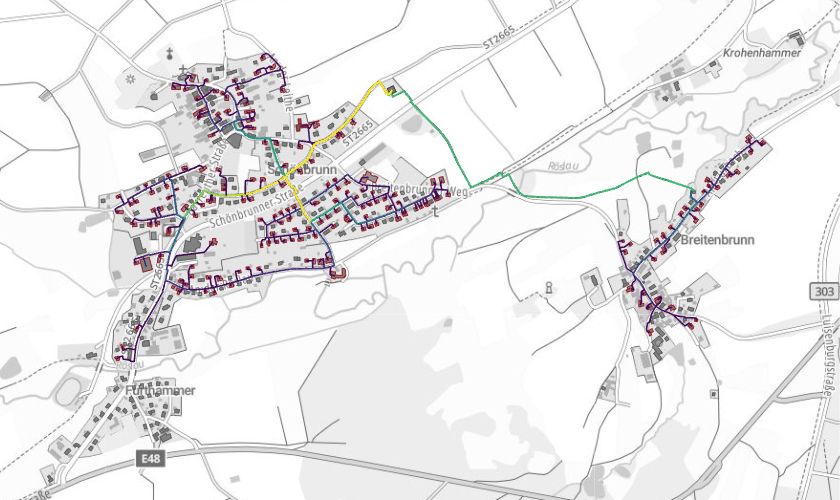
BeStWärmKI addresses precisely this need: the close integration of forecasting, simulation, and optimization creates a comprehensive digital process that supports both strategic decisions and subsequent real-time operation. The pilot operation in the heating network of Stadtwerke Wunsiedel provides the real-world application framework in which the developed methods are tested and further refined.
The role of heatbeat: modeling, simulation, and digital twin
heatbeat plays a central role in the project, mapping the real heating network in detail and with physical accuracy in the heatbeat digital twin. The digital twin encompasses all relevant network components—from generators and transfer stations to the hydraulic structure and building loads. By integrating annual consumption data, the modeling is continuously updated and accurately reflects the real network behavior.
One focus of the work is on providing two complementary simulation approaches:
Highly detailed dynamic models (based on Modelica/Dymola), which are particularly suitable for complex and time-variable operating conditions,
a fast thermo-hydraulic simulation that was developed specifically for the requirements of planned real-time operation and enables rapid scenario comparisons.
This combination of precision and computing performance is essential for verifying, validating, and iteratively improving the results of the mathematical optimization models. Special attention is also paid to flow temperature optimization, which heatbeat simulates and which will serve as a robust fallback strategy in pilot operation.
In addition, heatbeat is working with its project partners to develop an API-based infrastructure that enables the standardized exchange of forecast data, simulation parameters, and optimization results. This technical integration will enable a continuous, AI-supported control process—from data acquisition to the final control signal in the real grid.
Methodological advancement and sustainable added value
In addition to operational project work, BeStWärmKI also serves to further develop heatbeat's modeling and simulation methods. This includes more efficient numerical approaches, improved variant comparisons, and simplified derivation of operationally relevant key figures.
The models and processes created in the project form a robust foundation for future applications: they can be transferred to other heating networks, support digital transformation processes, and enable scalable, AI-supported network operation in the long term.