short facts
Duration
Jan 2025 - Jan 2026
Municipal heating planning was carried out for the municipal association Rheinauen in collaboration with EMCEL GmbH.
Jan 2025 - Jan 2026
Municipal heating planning was carried out for the municipal association Rheinauen in collaboration with EMCEL GmbH.
As part of the project, a comprehensive baseline analysis of all buildings to be supplied was first carried out. This included recording heat consumption and heat demand, existing heating systems, and building-specific information such as type of use, age of construction, and renovation status. A digital questionnaire was used to refine the data collection. All collected data was processed at the address level in the heatbeat Digital Twin and, in compliance with data protection regulations, aggregated into building blocks and made available to the Rheinauen municipal association (Verbandsgemeinde). Building on this, a potential analysis was conducted that identified both energy savings through renovation and optimization as well as locally available potentials for renewable energies and waste heat. These were visualized on an area-specific basis in order to provide a sound basis for decision-making.
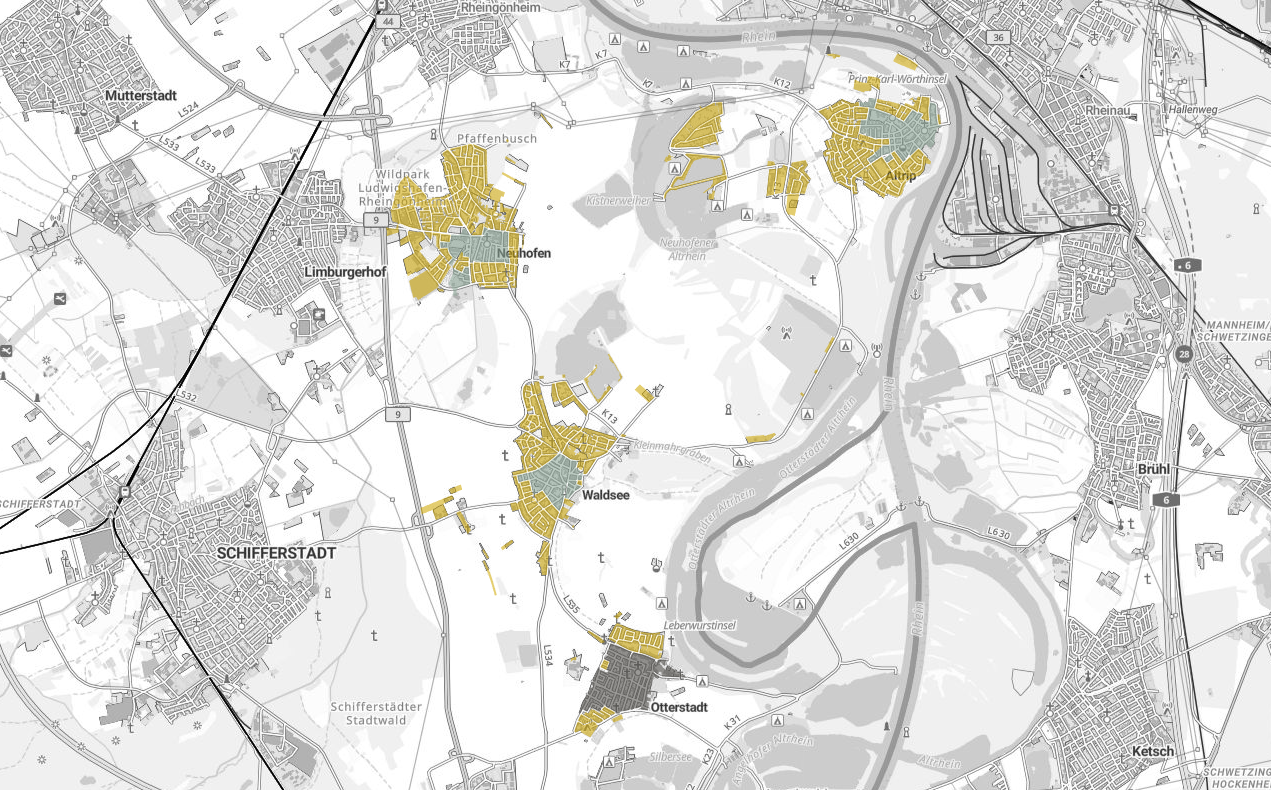
In the next step, the target scenario for the municipal heat plan was developed. This includes a georeferenced representation of the future heat supply, suitable areas for decentralized individual supply and heat networks, urban development policy objectives, and concrete proposed measures with short descriptions. In addition, the potential greenhouse gas reduction, a cost framework, and financing options were determined. In three of the four local municipalities, heat network areas were designated in the village centers (Altrip, Neuhofen, and Waldsee), and in the fourth local municipality a heat network assessment area was designated (Otterstadt). Since planning for a deep geothermal drilling project to supply district heating to the nearby city of Speyer is already underway within the municipal association's territory, heat network variants involving heat supply from deep geothermal energy were also calculated and analyzed.
The heat transition strategy specifies the path toward implementing the target scenario. To this end, heat sinks and heat sources were brought together, a transformation pathway was presented based on benchmark years, and measures for short-term implementation were prioritized. The concrete steps for implementation included, among others, the following points:
Feasibility studies for heat networks (including BEW funding) for the heat network areas and the assessment area,
Public relations and citizen participation,
Coordination with the company carrying out the planning for the deep geothermal project,
Information services on building renovation and heating systems.
Alongside these technical work packages, the project partner EMCEL GmbH was responsible for public relations, stakeholder management, and project management. Together with heatbeat and EMCEL, interactive workshops and citizen information events were held with municipal and regional stakeholders, in which interim results were presented and jointly developed further. In total, four citizen information events were held in hybrid form, both in person and via online participation, and three on-site stakeholder workshops took place. Finally, the results were presented individually to the political councils of the four local municipalities.
The heatbeat Digital Twin served as the central platform for visualizing and analyzing all project-related data. The block-level representation of building information and renewable energy potentials provided a precise and transparent basis for decision-making. The Digital Twin also enabled the georeferenced representation of the target scenario and supported the development of a realistic transformation pathway for the municipal heat transition.