Project overview
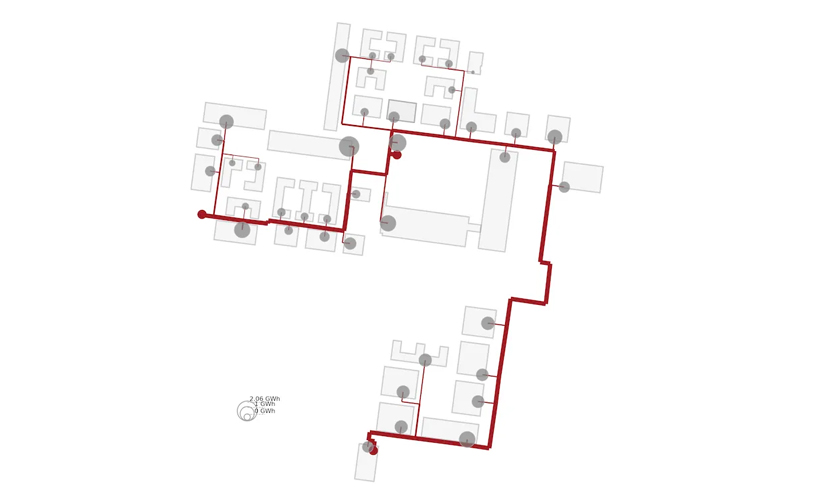
In Berlin, the Siemensstadt Square project is creating a smart campus of the future that combines digitalisation with energy efficiency and sustainability. A key challenge here is the sustainable supply of heating and cooling to the buildings. The key to this lies in making the best possible use of the local supply of renewable heat sources and distributing them efficiently in the urban context of the neighbourhood. To support this process, we have mapped the neighbourhood in our heatbeat Digital Twin and simulated and evaluated various supply options.
Our Contribution
The core of our work was to compare different heating and cooling network concepts for supplying the neighbourhood. This enabled us to highlight the advantages and disadvantages of the concepts under consideration in detail and thus contribute important insights for the further planning process. The focus was particularly on questions relating to network design (e.g. 2-pipe network vs. 4-pipe network), the integration of different heat sources (e.g. air and waste water heat pumps) and the demarcation of the supply area with a comparison of the heat densities of different construction phases.
Further information on the project is available on the official project website.