TransUrban.NRW – Heating and cooling networks as an energy platform in neighborhoods
In the TransUrban.NRW project, innovative fifth-generation heating and cooling networks are taking on the role of a modern energy platform. The aim was to balance heating and cooling requirements within a neighborhood as optimally as possible, while making efficient use of local renewable energy sources and waste heat. Digital processes accompanied the journey from the initial idea through planning to implementation and operation, enabling optimization potential and synergies to be identified and exploited at an early stage.
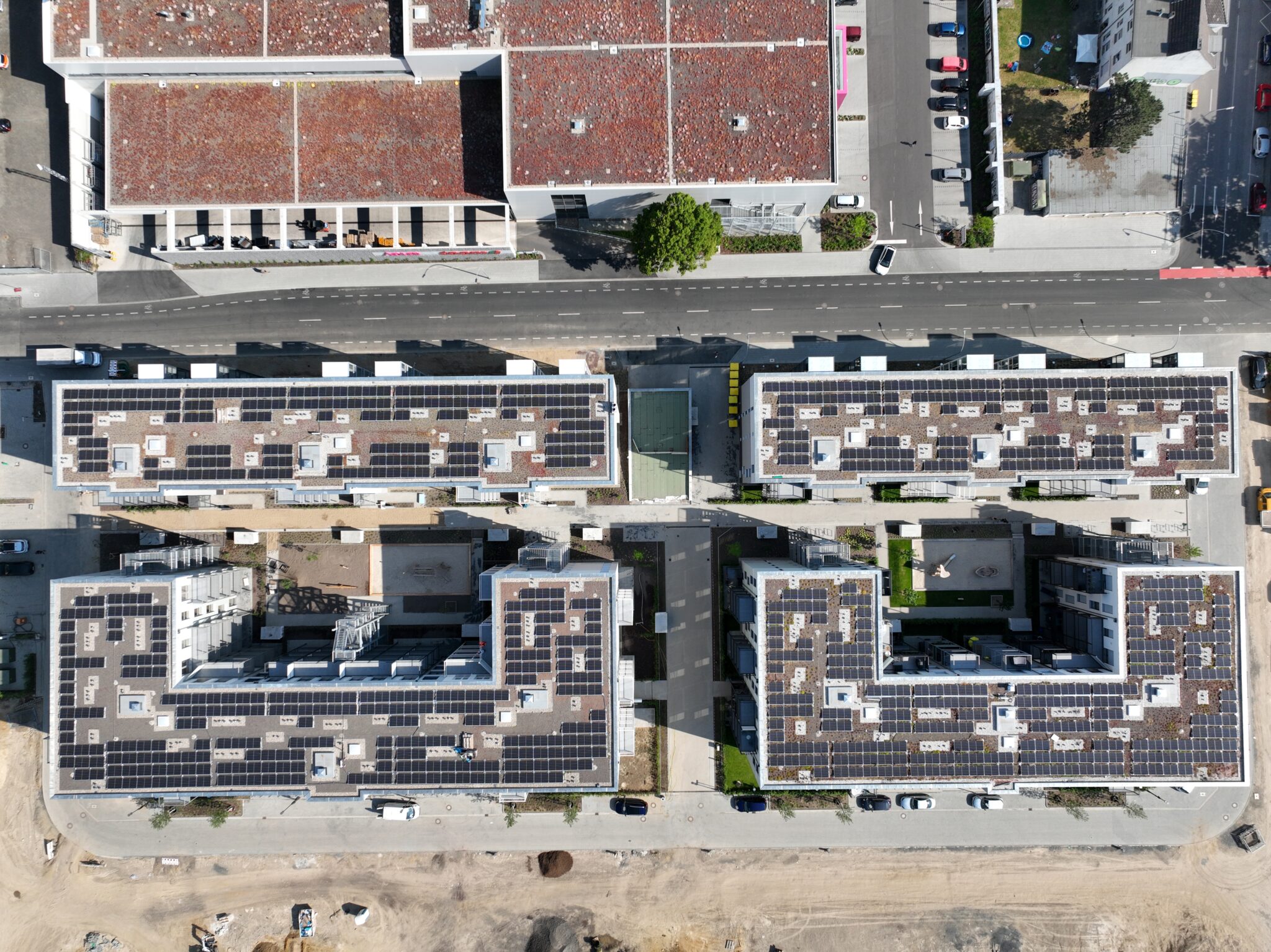
Four neighborhoods in different locations in North Rhine-Westphalia were planned as demonstrators: Kokerei Hassel in Gelsenkirchen, Shamrockpark in Herne, Seestadt mg+ in Mönchengladbach, and Düsselterrassen in Erkrath. The different conditions and stages of development provided a broad basis for testing the concepts developed in the project under real-life conditions. This created the conditions for applying and transferring the knowledge gained beyond the individual locations.
The role of heatbeat: modeling, simulation, and digital twins
In the TransUrban.NRW project, heatbeat focused on modeling and simulating heating and cooling networks. Dynamic system operation proved to be crucial, especially for 5th generation networks: low and variable network temperatures, bidirectional energy flows, and the close coupling of buildings, networks, and generators required digital tools that accurately map real system behavior.
In the project, the entire system operation was simulated in high temporal and physical resolution – from building loads to the behavior of transfer stations and the hydraulics of the network to the development of network temperatures, heat transfer in the ground, and the control of heating and cooling generators. This provided a reliable basis in the early planning phases for specifically analyzing and optimally utilizing the potential of cold, bidirectional networks.
Support for neighborhood planning and implementation
The models developed were used directly in the planning processes for the demonstration neighborhoods during the course of the project, closely linking analysis and real-world implementation. Among other things, they supported:
the evaluation of different network and supply concepts,
the dimensioning of pipe networks, heat pumps, and storage systems,
the analysis of load and temperature shift potentials,
and the development of robust operating and control strategies.
The dynamic simulations enabled critical operating conditions to be identified at an early stage, variants to be compared in detail, and decisions for implementation to be validated. The models thus acted as digital twins, continuously mapping planning statuses, integrating changes, and facilitating the transferability of the concepts.
Methodological advancement and lasting added value
In parallel with its practical application, TransUrban.NRW served as a research and development platform for the targeted advancement of heatbeat's modeling and simulation methods. The project further improved both the level of detail of the models and their numerical efficiency. In particular, the simulation times for dynamic annual simulations were significantly reduced, making it easier and faster to compare different variants.
The models and processes developed in the project have proven themselves in very different types of neighborhoods – from dense, complex networks with multiple feed-in points to bidirectionally operated, low-temperature heating networks with pronounced waste heat utilization. The insights gained in the process form a robust technical foundation for future projects and enable scalable, digitally supported planning of modern heating and cooling infrastructures.