short facts
Duration
7/2024 – 11/2025
Municipal heating planning was carried out for the Weiherhammer administrative community and the Mantel market town in cooperation with bayernwerk.
7/2024 – 11/2025
Municipal heating planning was carried out for the Weiherhammer administrative community and the Mantel market town in cooperation with bayernwerk.
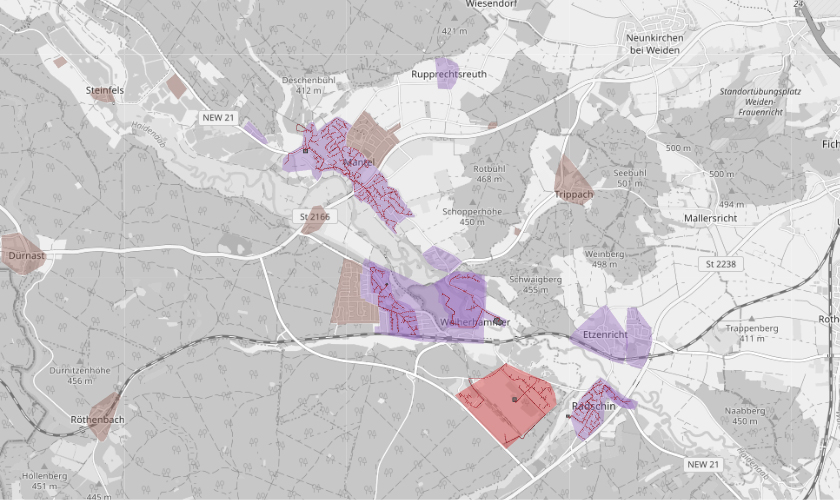
As part of the project, a comprehensive inventory analysis of all buildings to be supplied was first carried out. This involved recording heat consumption and heat requirements, existing heating systems and building-specific information such as type of use, age of construction and state of renovation. A digital questionnaire was used to collect more precise data, the results of which were mapped in detail in the heatbeat Digital Twin.
Based on this, a potential analysis was carried out, which identified both energy savings through renovation and optimisation as well as locally available potential for renewable energies and waste heat. These were visualised by area in order to create a sound basis for decision-making.
The next step was to develop the target scenario for municipal heat planning. This includes a georeferenced representation of the future heat supply, suitable areas for decentralised individual supply and heat networks, urban development policy objectives and concrete proposals for measures with brief descriptions. In addition, the potential greenhouse gas reduction, a cost framework and financing options were determined.
The heat transition strategy specifies the path to implementing the target scenario. To this end, heat sinks and sources were brought together, a transformation path was presented based on reference years, and measures for short-term implementation were prioritised.
Accompanying these technical work packages, project partner bayernwerk was responsible for public relations, stakeholder management and project management. Together with heatbeat and bayernwerk, interactive workshops were held with municipal and regional stakeholders, in which interim results were presented and further developed jointly. The project was concluded with detailed documentation and reporting.
heatbeat's services included:
Inventory analysis of all relevant buildings, including digital data collection
Block-specific modelling in the digital twin
Potential analysis for renovation, renewable energies and waste heat
Development of a target scenario for municipal heat planning
Support for strategic heat transition planning with prioritisation of measures, interactive workshops to involve local stakeholders, preparation of a final report with all relevant results
The heatbeat Digital Twin formed the central platform for visualising and analysing all project-related data. The block-specific mapping of building information and renewable potential provided a precise and transparent basis for decision-making. The Digital Twin also enabled the georeferenced representation of the target scenario and supported the development of a realistic transformation path for the municipal heat transition.