short facts
Duration
January 2023 - March 2025
A concept study was carried out for Stadtwerke Wesel GmbH on the construction of a district heating network using waste heat in the downtown area of Wesel.

January 2023 - March 2025
A concept study was carried out for Stadtwerke Wesel GmbH on the construction of a district heating network using waste heat in the downtown area of Wesel.
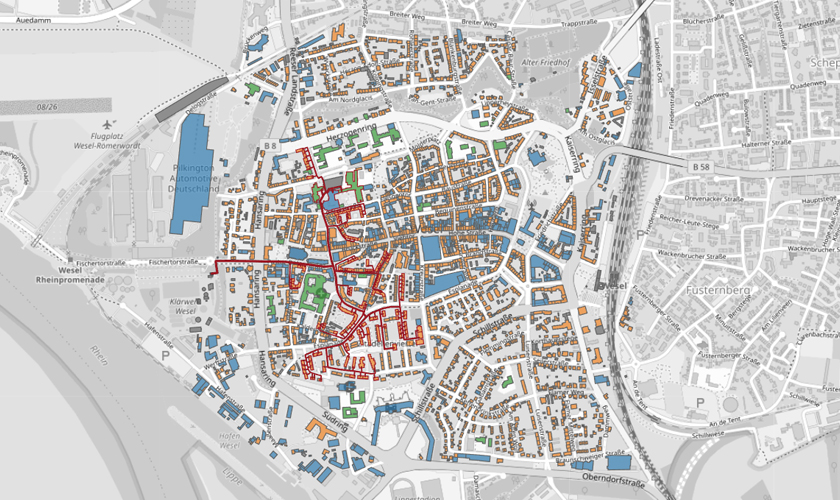
The concept study for heat network planning in Wesel includes an inventory and digitization of all buildings in Wesel. Together with Stadtwerke Wesel, anchor customers were defined for an initial expansion scenario from all buildings. A total of approx. 8 MW of power and 22 GWh of annual consumption are taken into account. Building-specific consumption data from gas bills is used to determine precise demand, while demand is estimated for buildings without measured values. All relevant data – including area, age of construction, consumption, and demand – is recorded and visualized with georeferencing.
An hourly heat demand load profile is developed to enable a dynamic demand estimate for the buildings. In addition, a potential analysis is carried out, which considers the output, energy, and hourly progression of the potential for one year. The focus here is on wastewater heat from the sewage treatment plant and the integration of a combined heat and power plant (CHP) as possible generation options.
Two variants with different connection rates are being examined for network planning. Each variant is evaluated in terms of routing, dimensioning, and costs. A section-specific cost estimate, supplemented by a pressure loss calculation and analysis of thermal losses, ensures technical feasibility. In addition, various energy system options are being designed, selected, and simulated. The focus is on heat pumps, CHP units, and short-term storage systems, which are tested for their performance and integration into the overall system. For a holistic system evaluation, the primary energy factors as well as absolute and specific CO₂ emissions are calculated. Finally, an economic evaluation is carried out to assess the long-term profitability of the scenarios examined.
The concept study was used as a basis for decision-making to apply for and implement Module I of the BEW (system planning). Stadtwerke Wesel was able to use the results ideally for communication with the sewage treatment plant, key customers, and further planning.